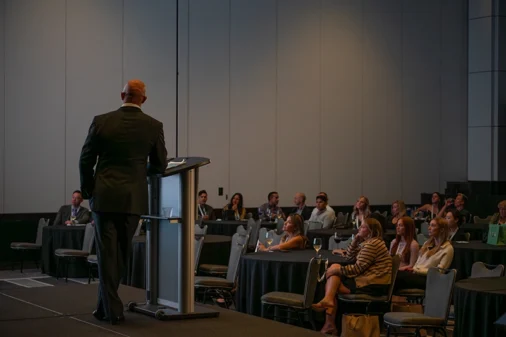
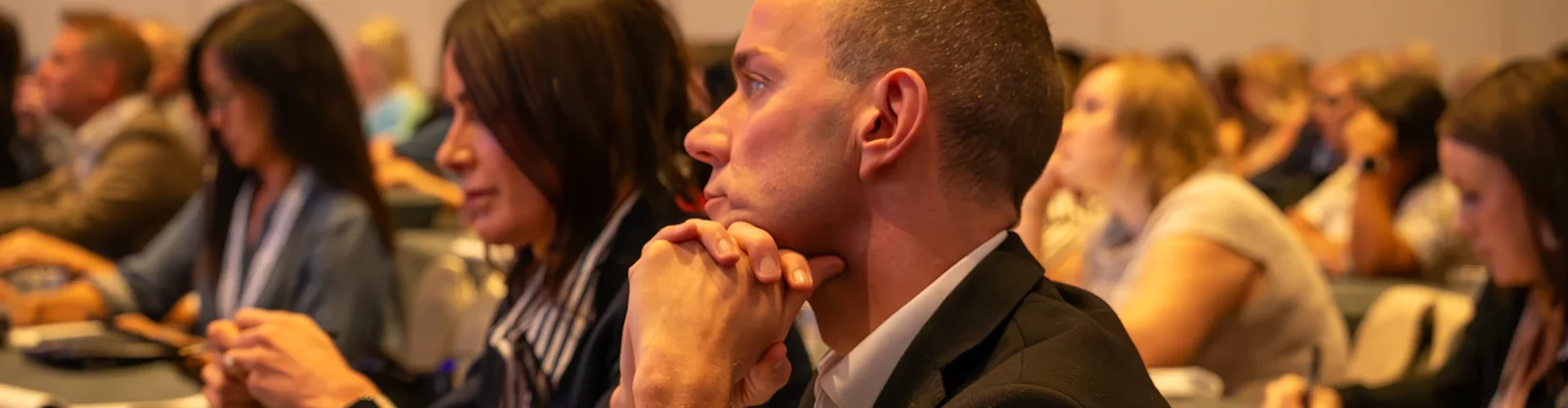
For four days in Miami, the Global Aesthetics Conference brought together surgeons, injectors and practice leaders to compare techniques, challenge assumptions and share what’s actually working in their practices right now. These sessions had attendees filling notebooks and rethinking workflows they’d had on autopilot for years.
If you weren’t able to attend last year, here are some of the most clinically and operationally relevant takeaways from the 2025 program, pulled directly from sessions covering different tracks and specialties.
Consider this a preview of what GAC 2026 has to live up to.
1. Operating on High-Risk Patients in the GLP-1 Era
Dr. Blake Raggio presented “How to Perform Facelift Surgery Safely in High-Risk Patients,” specifically addressing how to operate on patients using semaglutide. Dr. Charles Riccio also gave a talk on the “Impact of GLP-1 Medications on Surgical Cases.” With the increased popularity of injectable weight loss drugs, these sessions arrived at exactly the right moment.
That’s because the cosmetic side effects of rapid GLP-1-driven weight loss, including volume depletion, skin laxity and accelerated facial aging, are landing in your consultation room whether you want them to or not. And due to factors like nutritional status, healing timelines and body composition, the risk profile looks different in someone actively using semaglutide or tirzepatide. GLP-1 sessions helped attendees rethink their pre- and post-op protocols with these patients in mind.
2. The Optimum Mobility Facelift
Dr. Nabil Fanous demonstrated his Optimum Mobility Facelift technique during a live surgical video that made a compelling case for strategic mobilization over extensive undermining. The technique uses what he calls “smart” sutures and minimal dissection to achieve durable results.
For surgeons trained in more aggressive dissection planes, watching this approach work is genuinely recalibrating. The takeaway isn’t that the deep plane facelift is wrong. It’s that there are multiple valid roads to excellent outcomes, and understanding the reasoning behind each one makes you a better surgeon regardless of which technique you favor.
3. Deep Neck Contouring
Dr. Anil Shah’s Thursday afternoon session, “Improving Outcomes in Deep Neck Contouring — Leveraging Technology and Algorithms to Create Predictability,” tackled one of the more frustrating variables in facial rejuvenation surgery.
Neck lift results have a reputation for being harder to control than other facial areas. They’re more dependent on anatomy, more variable in healing, and more likely to be the thing a patient notices at the two-year mark. Shah presented a systematic algorithm for approaching deep neck cases that accounts for those variables. For surgeons who feel confident about their facelift but less certain about the neck, this session offered a clinical decision-making structure that’s immediately applicable.
4. Injectable Resurfacing as a Laser Alternative
Dr. Diane Duncan presented “Injectable Resurfacing: An Alternative to Lasers” on Thursday afternoon in the Less Invasive Strategies track, and followed it on Friday with a session on combining an injectable allograft matrix with autologous fat for nonsurgical face lifting.
The injectable resurfacing concept is worthwhile for practices that don’t have robust laser infrastructure, or for patients who aren’t laser candidates. Duncan’s approach uses injectables to achieve resurfacing-adjacent outcomes without the downtime or the equipment overhead. For injectors looking to expand what they can offer in a single appointment, this session presented a genuinely different tool.
5. 25 Years of Fat Grafting Knowledge
Dr. Edwin Williams presented “Conclusions and Nuances of 25 Years of Fat Grafting for Facial Rejuvenation” on Saturday afternoon, one of those sessions where the title undersells what’s actually being offered.
A quarter-century of fat grafting experience distilled into a presentation goes beyond a set of tips or techniques. Dr. Williams has watched his own results evolve across decades, made adjustments based on long-term follow-up that most surgeons haven’t had time to accumulate, and developed a specific philosophy about where fat grafting adds genuine value versus where it’s being used as a default.
For surgeons incorporating fat transfer into their facelift cases, this session offered a perspective that would take decades to develop on your own.
6. Regenerative Medicine as a Surgical Complement
Multiple sessions across the Less Invasive Strategies track addressed regenerative treatments as complements to surgical procedures. From PRP, PRF, exosome therapy and stem cell-adjacent approaches, the conversation has matured significantly from a few years ago when these treatments existed mostly outside mainstream surgical practice.
The current evidence supports combining regenerative approaches with facelifts to support healing and extend results, and with fat transfer to improve survival rates. For practices that haven’t yet developed a regenerative medicine offering, these are no longer fringe treatments. They’re becoming part of how comprehensive aesthetic care is defined.
7. AI in Aesthetic Practices
AI sessions at medical conferences have a tendency to be either breathlessly optimistic or uselessly abstract. GAC’s approach was neither. Sam Peek’s session on realistic AI applications for aesthetic practices cut through the noise and focused on what’s actually implementable today. Not in some theoretical future, but in your practice next quarter.
Other notable sessions included Vahe Tirakyan’s presentation on AI-powered practice optimization, how to rank for generative AI with Ryan Miller, and Jason Sievert’s talk on the AI-driven transformation of the healthcare landscape.
Each approached the topic from a different angle, and together, they highlighted where AI is actually delivering value in aesthetic practices right now: patient communication automation, lead conversion, inventory management, and search visibility in an era where AI overviews are changing how patients find providers.
8. The Saturday Morning Live Surgery Videos
This deserves its own entry because it isn’t really comparable to anything else at the conference.
On Saturday morning, starting at 6:30 a.m., five surgeons presented live surgical videos pulled directly from their own operating rooms. Each demonstrated a different approach: Dr. Nabil Fanous with his Optimum Mobility facelift, Dr. Edwin Williams with a preservation deep plane technique, Dr. Stephen Perkins with a composite deep plane facelift, Dr. Barbara Machado with her “round” deep plane approach, and Dr. Gaylon McCollough with a condition-specific analysis and demonstration.
Watching five surgeons with a combined century of facelift experience approach the same fundamental problem five different ways (straight from the OR with no editorial polish) is not something you can get from a journal article or a webinar. The value is in seeing the decision points, not just the outcomes. Attendees who watched these live videos left with a more nuanced understanding of facelift techniques they didn’t have the night before.
Before You Register
When & where is GAC 2026?
GAC 2026 takes place in November at the Loews Miami Beach Hotel in Miami Beach, Florida. The conference runs for four days, with sessions starting as early as 7:30 a.m. and running into the evening. Exact topics will be confirmed soon; check our website for the latest updates!
Who is GAC designed for?
GAC brings together professionals across four aesthetic specialties: facial plastic surgery, plastic surgery, dermatology and oculoplastic surgery. Our program also features dedicated tracks for practice managers, patient coordinators and marketing specialists.
Are there hands-on learning opportunities?
Yes, GAC partners with Marina Medical to provide off-site cadaver lab training. Spots are limited and fill up well in advance, so register early if you’re interested in this opportunity!
What should I do to prepare for GAC 2026?
First: register early! Those who plan ahead get the most out of their GAC experience. We also recommend booking your hotel and downloading the program agenda to map out your priorities. With 350+ sessions across multiple days, walking in without a plan could mean you’ll spend the first day figuring out logistics instead of learning.
Looking Ahead to GAC 2026
GAC 2025 delivered four days of practical insights, new techniques and candid discussions between some of the most respected voices in aesthetic medicine. If you want to be part of the conversations shaping the next generation of aesthetic care, pre-registration for GAC 2026 is now open! Click here to register now and plan your visit to Miami this November.